Orchestration
One agent doing everything is a bottleneck. PRISM uses specialized agents coordinated by thin orchestrators.
Parallel researchers, wave-based execution, dependency-aware scheduling, and real-time visibility into every agent's work. Orchestration that scales because no single agent carries the load.
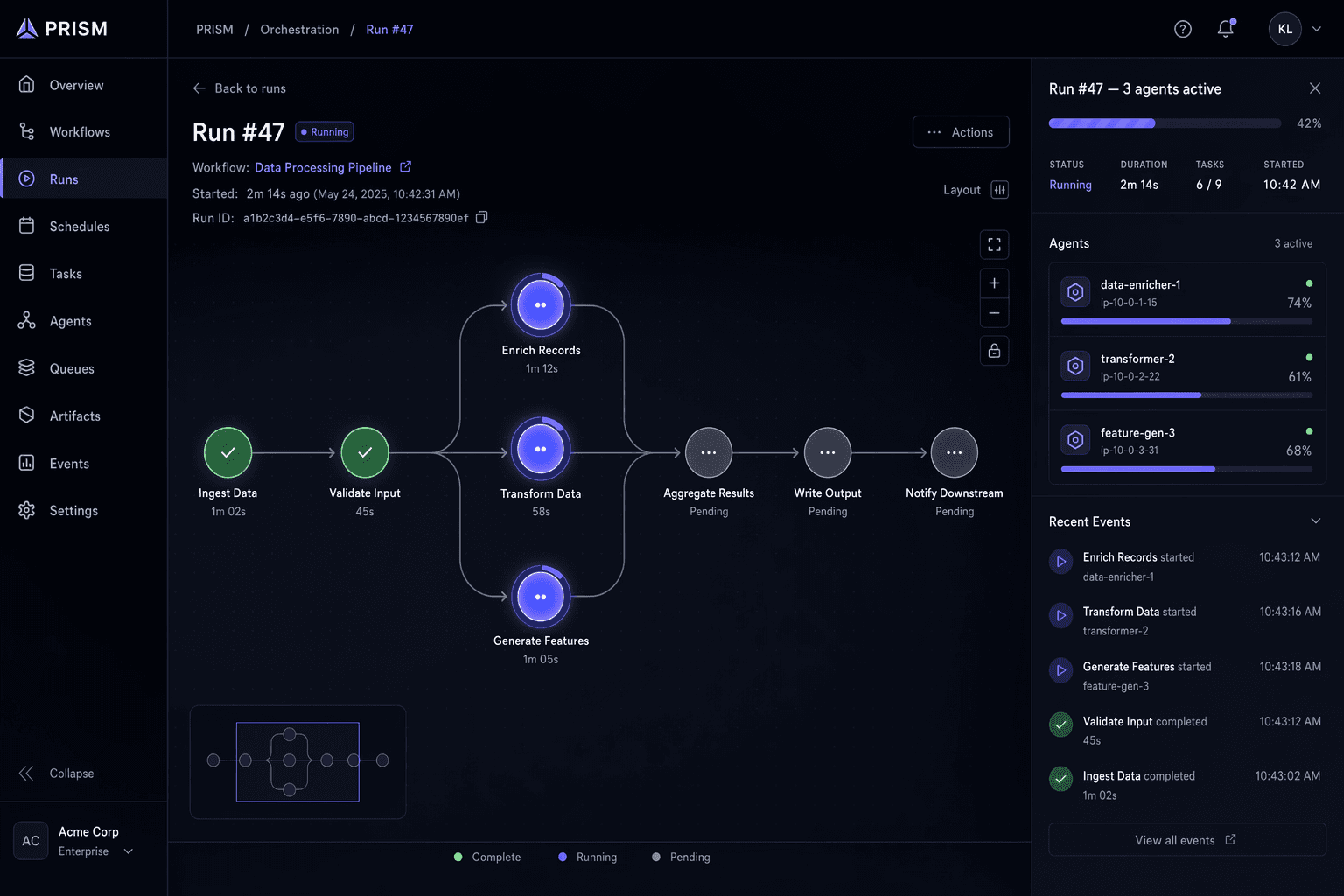
How orchestration works
Multi-agent coordination that turns delivery complexity into parallel, predictable execution.
4 parallel researchers per phase
Stack, features, architecture, pitfalls — each investigated by a dedicated researcher agent in its own context window. Results are synthesized and fed to the planner. No single agent tries to know everything.
Wave-based execution
Plans grouped by dependency into execution waves. Independent plans run in parallel across fresh context windows. Dependent plans wait for their predecessors. File conflicts handled by intelligent sequencing.
Plan verification loop
A checker agent verifies every plan against the original requirements before execution starts. If the plan doesn't satisfy the goal, it loops back for revision. Execution only begins when the checker passes.
Thin orchestrator pattern
Orchestrators coordinate — they don't execute. Each orchestrator dispatches to specialized agents (researcher, planner, executor, verifier) and stays under 30% context utilization. No bottleneck, no context rot.
Dependency-aware DAG scheduling
Tasks are organized into a directed acyclic graph. The scheduler identifies the critical path, parallelizes where possible, and sequences where necessary. You get maximum throughput without ordering conflicts.
Real-time streaming execution
Watch every agent in real time. Tool calls, code writes, file changes, and checkpoints stream to the execution UI. You see what's happening, not just what happened.
From requirement to verified code
01
Research
4 parallel agents investigate stack, features, architecture, and pitfalls.
02
Plan
Synthesized research feeds the planner. Plans verified against requirements before execution.
03
Execute
Wave-based execution across fresh context windows. Independent tasks in parallel, dependent tasks sequenced.
04
Verify
Goal-backward verification checks the codebase delivers what the requirement specified.
Stop running agents in sequence
See wave-based multi-agent execution in action. Start a 14-day pilot and watch parallel delivery at work.